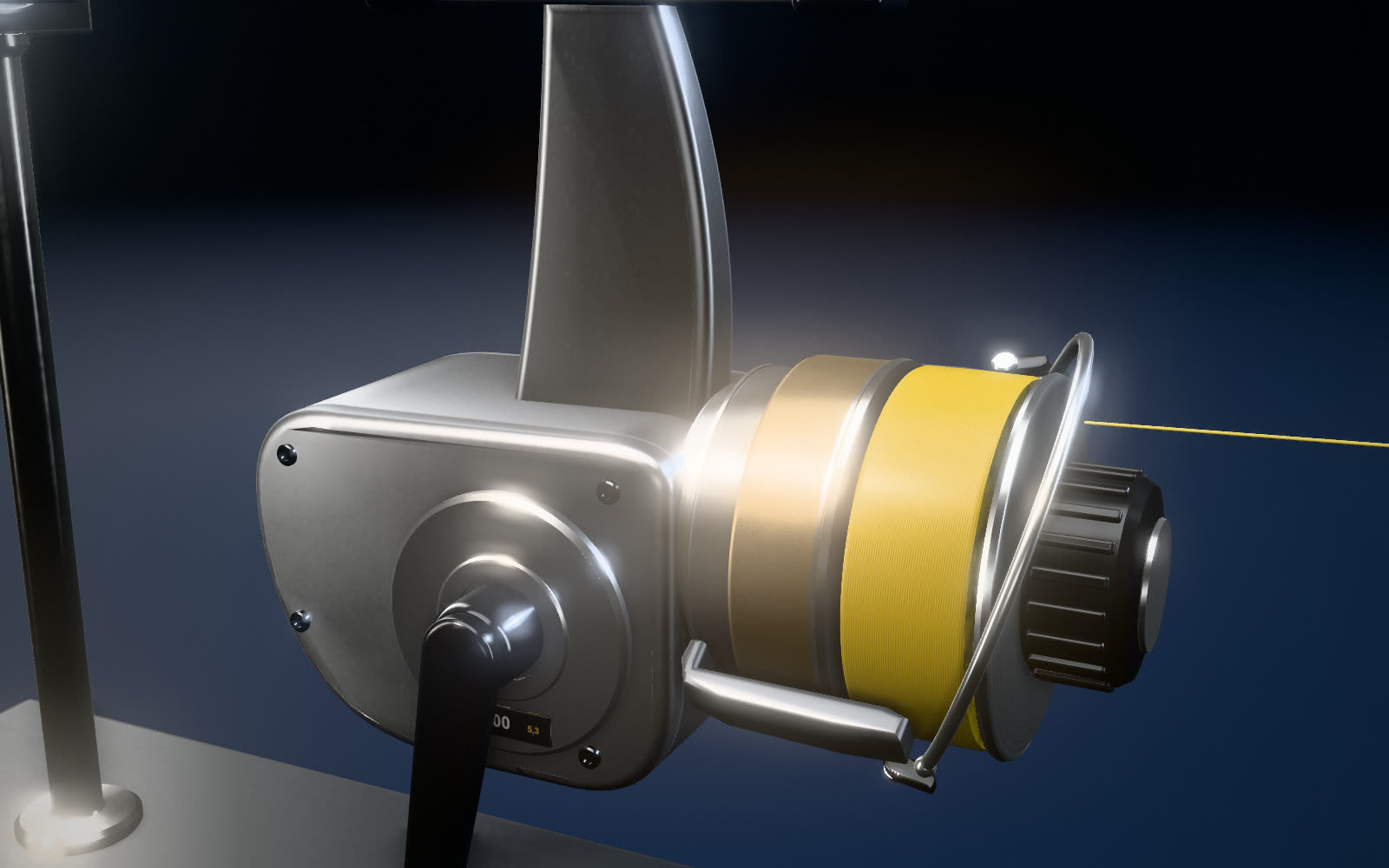
What is it?
On a spinning reel the spool stays still and a rotor turning around it lays the line on. To cast you open the bail and the line peels off the end of the spool by itself; because the spool never spins, backlash is almost impossible.
That is why a spinning reel is most anglers' first reel: it casts light lures far, it is easy to learn, and one reel covers everything from sea bass and bluefish to wrasse and small mackerel.
When to choose it
- Shore and rock fishing with light to medium lures
- Long casts with thin braid or mono
- Beginners: almost no risk of backlash
What the lab computes
The slider sets handle speed. The drive gear has 48 teeth and the pinion 9, so the rotor turns 5.33 times per handle turn. Retrieve speed is v = n·i·π·D, where D is the current diameter of the line on the spool (49.6 mm when full). At one handle turn per second the rotor spins at 320 rpm and line comes in at 0.83 m/s — very close to the 82 cm per turn that makers quote for this class.
The oscillation system carries the spool 17 mm forward and back every 1.9 handle turns, so line is wound crosswise into a flat cylinder.
With “Fish runs” the handle stops and the anti-reverse clutch locks the rotor; line can only leave through the drag. Drag torque is T = μ·F·r·n = 0.15 × 259 N × 7.4 mm × 3 faces ≈ 0.87 N·m. As line goes out the diameter shrinks, so the pull rises from 3.56 to 3.81 kgf. The fish's power at 3 m/s (≈ 110 W) becomes heat in the drag washers: they reach about 93 °C and the spool 53 °C. This run stays below 120 °C, where drag grease thins and the drag fades.
Part by part
- Reel foot
- The flat foot that clamps into the rod's reel seat.
- Body
- The housing that carries and aligns the gear train. A rigid body keeps the gears in mesh under load.
- Side cover
- Closes the side of the body; remove it to reach the drive gear and oscillation system.
- Handle
- Turns the drive-gear shaft. Its length sets how much torque you apply for the same force.
- Handle knob
- The grip your fingers turn; it spins on its own small bearing.
- Drive gear
- A 48-tooth face (hypoid) gear on the handle shaft. It turns the 9-tooth pinion; the tooth ratio gives the reel its 5.33 : 1 gear ratio.
- Pinion gear
- The small hollow gear driven by the drive gear; it spins the rotor and the main shaft runs through it.
- Main shaft
- Carries the spool. It does not rotate; it moves in and out with the oscillation system so line is laid evenly.
- Oscillation system
- Moves the main shaft back and forth as you crank, so line is wound flat rather than in a cone.
- Ball bearings
- Ball bearings on the handle shaft, pinion and line roller cut friction; quality and corrosion resistance matter more than the count.
- Anti-reverse clutch
- A one-way clutch that stops the rotor turning backwards, so a running fish takes line from the drag, not the handle.
- Rotor
- Spins around the spool and wraps the line on. If it is out of balance the reel wobbles at speed.
- Bail arm
- Opened for the cast; when you crank it snaps shut, catches the line and guides it to the line roller.
- Line roller
- The small roller at the end of the bail where the line turns; if it seizes it wears and twists the line.
- Spool
- The stationary spool that holds the line. A larger lip diameter recovers more line per turn.
- Line
- Fill to about 1–2 mm below the spool lip for the longest casts.
- Drag knob
- The front-drag knob. Tightening it presses the drag washers harder, raising the force a fish needs to take line.
- Drag washers
- A stack of 3 carbon and 3 stainless washers inside the spool. They slip to give line to a running fish and turn that work into heat.
- Rod blank
- The rod section and reel seat the reel is mounted on.