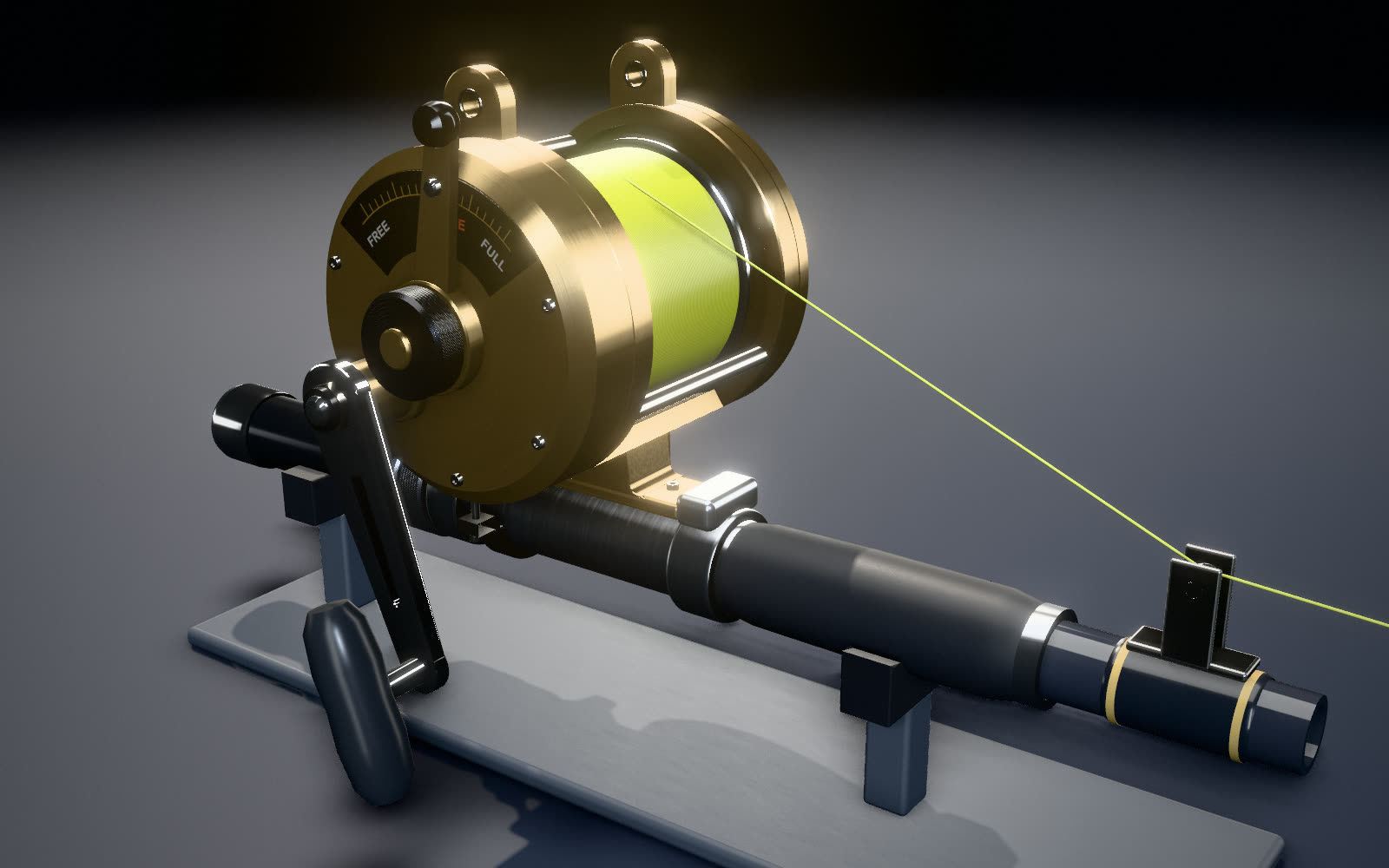
What is it?
On a conventional reel the spool turns on an axis across the rod and winds line on directly. On a lever-drag model the drag is set by a lever on the side rather than a star: pushing it forward presses a carbon drag plate against the spool's stainless pressure plate.
That means a large drag surface that can shed heat, and a setting you can repeat: the strike mark on the quadrant starts every fight at the same force. It is the reel for trolling, big tuna, swordfish and deep jigging.
When to choose it
- Trolling and big pelagics (tuna, swordfish, amberjack)
- Long, heavy fights where the drag must handle heat
- Boat fishing with a harness and fighting belt
What the lab computes
The slider moves the drag lever. The lever turns a cam, and over 1.1 mm of travel the cam compresses two Belleville springs. Their force (0.86 kN at strike, 1.63 kN at full) presses the carbon drag plate onto the spool's stainless plate, so drag torque is T = μ·F·r (μ ≈ 0.13, effective radius 29.6 mm). The force you feel on the line is that torque divided by the line's current winding radius on the spool.
The “Tuna run” button hooks a fish of about 250 kg. As it takes line the winding radius shrinks from 42.3 mm, so the drag force rises even though the lever never moves — at full drag it reaches 27 kgf on a nearly empty spool. The model shows the fish stopping after 467 m at the strike setting, while at full drag the line tension (drag plus the line's drag through the water) passes 23 kgf and parts the line at 247 m. Meanwhile the drag face heats past 200 °C.
On the water this means: start the fight at strike, back the lever off as the spool empties, and push it forward again as you gain line.
Part by part
- Frame
- A one-piece machined aluminium frame; it keeps the side plates from flexing and the gears in mesh under heavy load.
- Side plates
- Carry the spool-shaft bearings; the handle side houses the gears and the drag mechanism.
- Spool
- A wide spool holding hundreds of metres of line. As line goes out the winding radius shrinks, which changes the drag force.
- Line
- Line of a set class (e.g. 24 kg / 50 lb). The drag is set to stay below its breaking strength.
- Drag lever
- Pushing it forward drives a cam that presses the drag plate onto the spool. In free, the spool spins freely.
- Strike preset
- Sets the cam's free play; in the model it gives 8 kgf at the strike stop on a full spool, a third of the line class.
- Drag plate
- The carbon disc that rubs on the spool's stainless plate, turning the fish's work into heat.
- Belleville springs
- Two dished springs in series; they turn 0.4–0.84 mm of cam squeeze into 0.86–1.63 kN of clamp force, with no steps.
- Drive gear
- Two bronze drive gears (47 and 37 teeth) on the handle shaft: high gear (3.9 : 1) picks up line fast, low gear (1.7 : 1) lifts a heavy fish.
- Pinion gear
- The small gear on the spool shaft, driven by whichever drive gear is selected.
- Two-speed button
- Push to switch between high and low gear.
- Handle
- A long arm gives more torque on a heavy fish.
- T-bar knob
- A T-shaped knob for a full-hand grip.
- Harness lugs
- Lugs for the harness clips, transferring the fish's load to the angler's body.
- Clicker
- Clicks when the spool turns; it lets you hear a strike while trolling.
- Rod clamp
- Locks the reel to the rod at a second point, besides the foot.
- Pillars
- Cross bars that tie the side plates together.
- Ball bearings
- Stainless bearings carrying the spool shaft and gear shafts.
- Reel foot
- Seats the reel in the rod's reel seat.
- Rod blank
- A section of heavy roller-guide trolling rod.