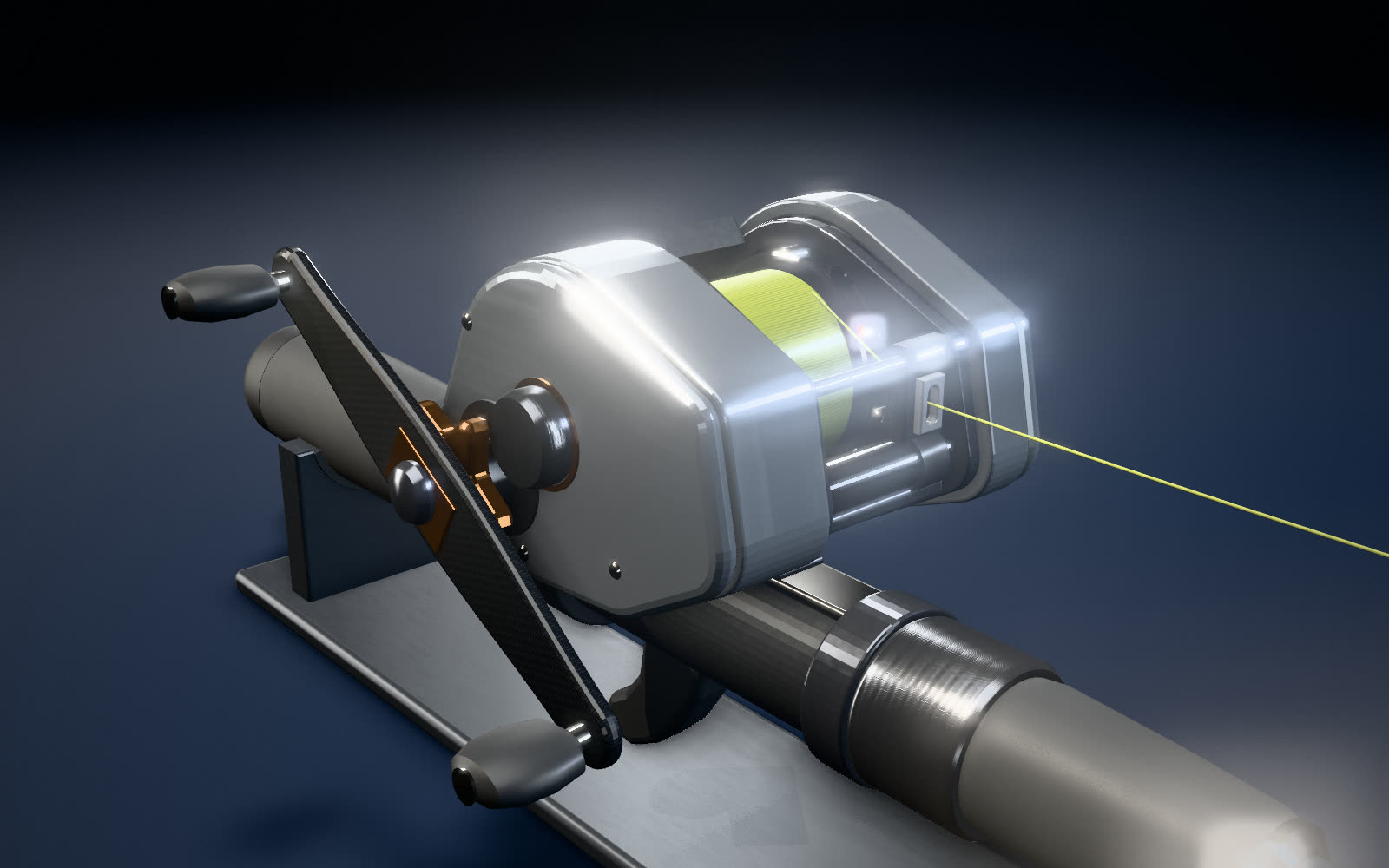
What is it?
On a baitcasting reel the spool itself spins during the cast. The lure slows down in the air, but the spool's inertia wants to keep turning. When the spool pays out line faster than the lure pulls it, the extra line balloons off the spool: a backlash, or bird's nest.
A magnetic or centrifugal brake closes exactly that gap. Set right, a baitcaster casts a given lure more accurately than a spinning reel, never twists the line, and sits on top of the rod for more leverage on a hard-fighting fish.
When to choose it
- Accurate casting of medium to heavy lures (jigs, crankbaits, swimbaits)
- Bass and pike; heavier line for bottom and jig fishing at sea
- Long sessions where line twist is unwanted
What the lab computes
Each cast is solved numerically from start to finish: a 14 g lure is released at 25 m/s and 30°, and gravity and air drag (½ρ·CdA·v²) slow it down. The spool turns only because the line pulls it, and its inertia (I) comes from the model's real volume and the density of aluminium. The magnetic brake applies torque in proportion to spool speed, T = k·s²·ω, growing with the square of the setting s on the slider.
When the spool pays out more line than the lure pulls, the difference builds up as slack. At brake 5 the spool peaks at 14,500 rpm, slack stays at 19 cm and the lure lands at 34.2 m. At 10 the cast is clean but ends at 18.6 m. At 3.5 and below slack passes 0.6 m: a backlash.
The “Brakes off” button sets the brake to zero. 0.3 s after release the slack limit is passed, the line jams on the spool at 8.3 m and 5.7 m of tangled line is left on the spool. The right setting sits between these two extremes, depending on lure weight and wind.
Part by part
- Frame
- The skeleton that holds the spool and gears in line; usually aluminium or magnesium.
- Palm-side plate
- The side plate under your palm; most reels keep the cast brake on this side.
- Handle-side plate
- Houses the gear train and carries the star drag and handle.
- Spool
- The 8.7 g aluminium spool that spins up to 14,500 rpm on the cast. The lighter it is, the less inertia it carries and the easier light lures cast.
- Line
- Line leaves the spool straight, without twisting.
- Level wind
- Guides the line from side to side while you reel, so it never piles up in one spot.
- Worm shaft
- A double-helix shaft geared to the spool; it drives the level wind back and forth.
- Thumb bar
- Press it to disengage the pinion from the spool so it free-spools for the cast; turning the handle re-engages it.
- Magnetic brake
- Magnets induce eddy currents in the spinning aluminium spool; braking rises with spool speed, so it works hardest early in the cast.
- Brake dial
- Moves the magnets closer to or further from the spool. Turn it up in wind or with light lures.
- Cast control knob
- Puts light pressure on the end of the spool shaft. Set it so the lure drops slowly from the rod tip.
- Star drag
- The star-shaped wheel behind the handle that compresses the drag washers.
- Handle
- A balanced double-paddle handle that turns the drive gear.
- Handle knobs
- The knobs at each end of the handle.
- Drive gear
- A 71-tooth brass drive gear; with the 10-tooth pinion it gives 7.1 : 1, so the spool turns 7.1 times per handle turn.
- Pinion gear
- The small gear on the spool shaft; it slides out of engagement when you press the thumb bar.
- Ball bearings
- The spool bearings directly affect casting distance; keep them clean and lightly oiled.
- Reel foot
- Clamps the reel into the rod's trigger reel seat.
- Rod blank
- The rod section and trigger reel seat.