Barbus barbus
Season calendar
- Season
- May–October
- Water temperature
- 12–22 °C
- Spawning
- May–June
- Behaviour
- Daytime bottom forager
Techniques
- Feeder Fishing
- Bottom Rig
- River Fishing
Baits
- Halibut pellets
- Boilies
- Luncheon meat
- Maggots and casters
- Sweetcorn
Where and when
- Scours at the end of gravel bars, fast water under bridges, and riprap banks.
- May to October is the productive window; feeding picks up clearly above 14 °C.
- It responds very well on summer nights and in coloured water after rain.
Method
- Feeder: 60-120 g cage, with maggots, cubed cheese, pellets or sweetcorn.
- Trotting: let the lead touch bottom and roll it slowly; the bite is sharp and unmistakable.
- 0.28-0.35 mm mainline and a strong size 6-10 hook; it fights long and stubbornly in current.
Spawning runs May-June; check cantonal minimum sizes and closed periods.
Barbel fishing in the UK
- Barbel are one of the UK's most popular river species. The Trent, Severn, Wye, Thames, Kennet, Great Ouse, Dorset Stour and Hampshire Avon are among the best-known rivers.
- In England and Wales, the coarse fishing close season on rivers runs from 15 March to 15 June, so the barbel season opens on 16 June.
- Summer evenings and nights, and rising, coloured water after rain, are prime times.
- Many clubs and fisheries have their own rules on baits, rigs and night fishing, so read the rules before you fish.
How to identify a barbel
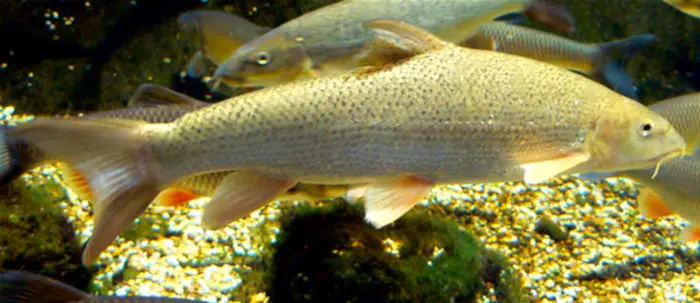
- A long, rounded body with a bronze to olive back and a flat belly suited to life on the riverbed.
- An underslung mouth with fleshy lips and four barbels, two on the upper lip and two at the corners of the mouth.
- Young barbel are often mistaken for gudgeon, which only have two barbels.
Size
- Fish of 3–8 lb are typical; a barbel over 10 lb is a specimen on most rivers.
Best baits for barbel
- Halibut pellets: drilled and hair-rigged, with loose pellets in the feeder.
- Boilies: small, fishmeal-based boilies are a classic on big rivers.
- Luncheon meat: cubed or torn, especially good in floodwater.
- Maggots and casters: fed heavily through a feeder, they often bring several bites in a row.
- Sweetcorn: cheap and effective on pressured rivers.
Rig and approach
- A heavy feeder or fixed lead with a hair rig, size 8–12 hook and 12–15 lb mainline.
- Feed regularly with hemp and pellets to hold fish in the swim.
- Fish the gravel runs, the tail of weed beds and the crease where fast water meets slow.
- Bites are violent: always keep a hand near the rod or use a secure rest.
Barbel welfare
- Barbel fight hard and can be exhausted after capture. Rest them in the net, then hold them upright facing into the current until they swim off strongly.
- Barbel roe is poisonous. The species is almost always released in the UK.
Frequently asked
- When is the best time to catch barbel?
- The productive window for barbel runs May–October. May–June is the spawning period; releasing your catch during these months is strongly advised.
- What water temperature does barbel feed in?
- Barbel is most active between 12 and 22 °C. Outside that band its feeding rate drops off.
- What bait works for barbel?
- The baits that stand out: Halibut pellets, Boilies, Luncheon meat, Maggots and casters, Sweetcorn.
- How do you fish for barbel?
- Common methods: Feeder Fishing, Bottom Rig, River Fishing.