Coregonus pollan
Season calendar
- Season
- June–November
- Water temperature
- 4–14 °C
- Spawning
- January, November–December
- Behaviour
- Cold water, feeds on the drift
Techniques
- Not an angling target (commercial netting)
What is a pollan?
- A freshwater whitefish (genus Coregonus), related to salmon and trout, that lives in a few large Irish lakes.
- It is closely related to the Arctic cisco and is thought to be a relic of the last Ice Age, cut off when the sea level rose.
- Its closest British relatives are the powan of Scotland, the gwyniad of Wales, and the schelly and vendace of England.
How to recognise it
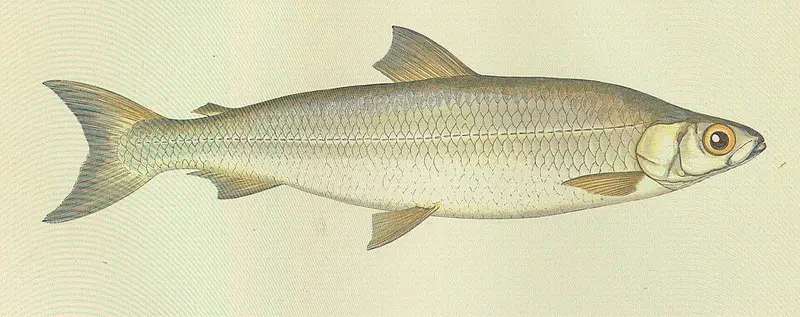
- A slim, silvery, herring-like fish with a darker blue-green back.
- A small mouth, large eyes and a small adipose fin (the fleshy fin between the dorsal fin and the tail), which shows it belongs to the salmon family.
- Most adults are 20–30 cm long.
Where pollan live
- Lough Neagh holds by far the largest population.
- Smaller populations survive in Lower Lough Erne and in the Shannon lakes, including Lough Ree and Lough Derg.
- They stay in deep, cold, well-oxygenated open water and move to shallow gravel to spawn in winter.
Why pollan are rarely caught on rod and line
- They feed almost only on zooplankton and ignore baits and lures.
- The Lough Neagh fishery is a licensed commercial net fishery.
- If you hook one by accident, release it quickly in the water with wet hands.
Threats and conservation
- Pollan are considered threatened in Ireland. The main pressures are water pollution (nutrient enrichment), invasive species such as the zebra mussel, and warming water.
- Because they need cold, clean water, pollan numbers are a good indicator of the health of the lake.
Frequently asked
- When is the best time to catch irish pollan?
- The productive window for irish pollan runs June–November. January, November–December is the spawning period; releasing your catch during these months is strongly advised.
- What water temperature does irish pollan feed in?
- Irish pollan is most active between 4 and 14 °C. Outside that band its feeding rate drops off.
- How do you fish for irish pollan?
- Common methods: Not an angling target (commercial netting).